Loading...
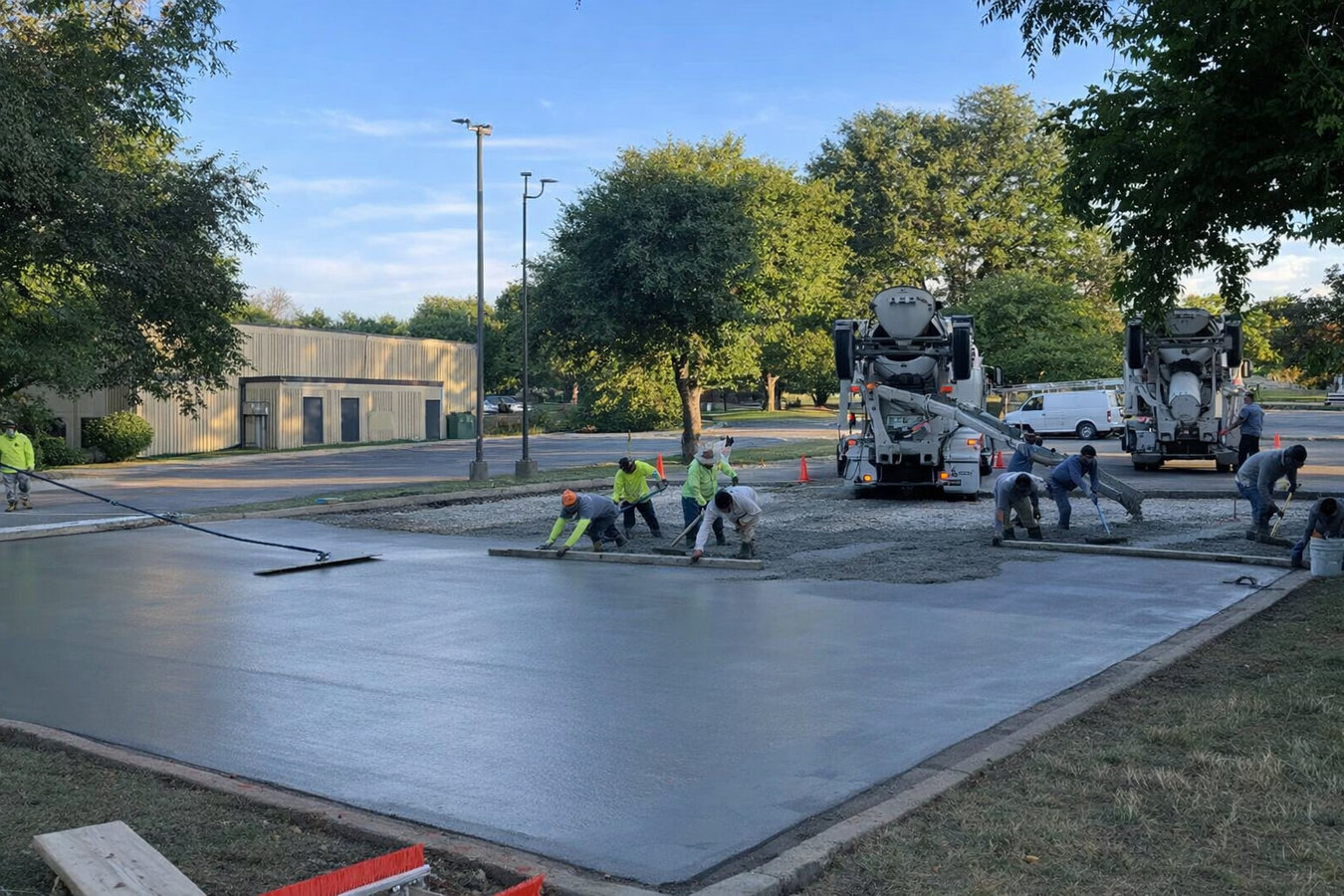
Tired of mud, ruts, or crumbling asphalt? We build concrete parking lots that stay firm through Indiana winters and look professional for decades.
Concrete parking lot building in Peru means excavating the ground, laying a compacted gravel base, and pouring a reinforced slab built to handle Indiana freeze-thaw cycles - most residential and small commercial lots take a few days to a week of active work, plus curing time. When that lot is properly graded and sealed, you get a surface that performs the same in a muddy April as it does in a dry August.
If you have been dealing with gravel that kicks up dust, asphalt that needs patching every spring, or soft ground that turns to ruts after rain, a concrete lot solves all of those problems at once. Miami County soils are largely clay-heavy, which is exactly why base preparation and drainage design matter here more than almost anywhere else.
If your project involves individual vehicle spaces near a structure, you may also want to look at our concrete driveway building service, which covers residential access surfaces with the same approach to base depth and drainage.
If vehicles are stirring up dust in summer or getting stuck in mud after spring rain, the current surface is no longer working. Deteriorating asphalt with recurring potholes is reaching the end of its practical life. Patching repeatedly costs more over time than replacing with concrete.
Miami County's clay soils can turn an unpaved lot into a minefield of ruts after a wet spring. The clay absorbs water and softens, and vehicle traffic compresses it unevenly. These ruts harden when the ground dries, making the surface worse each cycle. Concrete eliminates the problem entirely.
A growing business, additional tenants, or more regular visitors can quickly outrun an informal parking setup. An undefined or undersized area means vehicles parking on grass, blocking each other in, or making access awkward. A properly laid-out concrete lot fixes all of that.
Buyers and tenants notice parking quality immediately. A clean, durable concrete lot signals the property has been maintained well and reduces the negotiating leverage of a deferred maintenance item. It is one of the more visible upgrades you can make before putting a property on the market.
Our concrete parking lot building work covers everything from site assessment through the finished, sealed surface. We handle the permit process, excavation, base preparation, forming, reinforcement, and the pour itself - then walk you through the curing period and sealing schedule before we leave. Every lot is graded for positive drainage so water moves away from buildings and edges, and control joints are placed at the right intervals to manage cracking predictably.
For properties that need more than just a flat lot, we also do concrete footings for the structures that sit alongside or above the paved area. If you need access paths from the lot to a building, our concrete driveway building service covers those connections as well.
Suits residential properties, small businesses, and rental properties replacing gravel, dirt, or aging asphalt with a permanent concrete surface.
Suits properties where an existing paved area needs to grow to accommodate more vehicles, with matched drainage and control joints.
Suits business owners and property managers who need a professional-grade surface that handles regular traffic without the maintenance cycle of asphalt.
Suits properties where gravel has become a maintenance burden - rutting, dust, and spread - and a permanent surface is the practical solution.
Peru sits in north-central Indiana, where winters bring repeated freeze-thaw cycles from roughly November through March. Water that works into voids beneath an improperly built slab freezes, expands, and breaks the surface apart - and Miami County's clay-heavy glacial soils make the base preparation step even more critical than it might be elsewhere. A lot built with a shallow base on poorly compacted clay will crack and heave within a few years, no matter how good the concrete mix was. We build for what this climate actually does to pavement.
We work across the area, including Logansport and Kokomo, where commercial property owners face the same freeze-thaw challenges as customers in Peru. The flat terrain in the Wabash River valley also means drainage has to be designed in deliberately - water does not run off on its own the way it would on a sloped site.
We visit your property, measure the area, and assess drainage and soil conditions. You get a written estimate covering excavation, base, concrete, and finishing - no vague line items. We reply within 1 business day.
We handle the permit application with the city or county building office. Once approved, we excavate to the correct depth, install and compact the gravel base, and grade for drainage. This step is the foundation of how long your lot lasts.
Forms go up around the perimeter, steel reinforcement goes in, and the concrete is poured and finished with a textured surface. Control joints are placed at planned intervals so any future cracking runs along predictable lines, not across the slab at random.
We protect the fresh surface with a curing compound and keep vehicles off for at least a week. Once the concrete has fully cured - typically several weeks later - sealing is strongly recommended. We walk you through the sealing schedule before the job is closed out.
We will visit your property, assess the site, and give you a clear written quote. No pressure, no obligation.
(765) 919-8766Miami County's clay-heavy glacial soils shift with moisture, and a base that isn't deep enough or well-compacted will let the slab above it heave and crack. We size and compact the base for the soil conditions we actually find on your site. That is one detail that separates a lot that lasts decades from one that needs repairs within a few years.
Flat lots in the Wabash River valley do not drain themselves - positive slope has to be built in deliberately. We grade every lot so water moves toward an appropriate outlet and does not pool near buildings or edges. Poor drainage is one of the main reasons concrete parking lots fail prematurely, and we address it before the forms go up. The American Concrete Pavement Association publishes guidance on pavement drainage that informs how we approach each project.
We handle the permit application with the local building office and treat inspections as a normal part of the job - not an inconvenience. A permitted lot has a paper trail that protects you as the property owner and confirms the work meets local requirements. We do not ask you to skip steps that protect you.
In Indiana's climate, sealing is not optional - it is what keeps moisture from penetrating the slab and starting freeze-thaw damage from the inside. We apply sealer after the concrete has fully cured and walk you through a resealing schedule before the job closes. You will know exactly what to do to protect your investment going forward.
Every parking lot we build is designed to perform in Peru's specific climate and soil conditions. When you call for an estimate, you get a straight conversation about what your site needs - not a template proposal.
Below-frost-line footings for the structures that sit alongside or above your paved surfaces.
Learn MoreResidential access driveways built with the same base preparation and drainage principles as our parking lots.
Learn MoreSpring and summer project slots fill fast - reach out now to get your site visit scheduled before the busy season.